


Chief AI Officer Parminder Bhatia discusses GE HealthCare’s vision for artificial intelligence in medtech and what’s needed to get there.


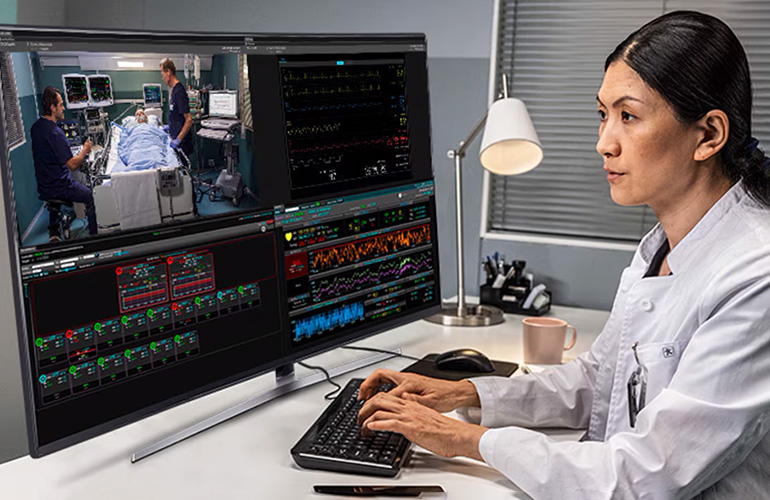
GE HealthCare says its Mural Clinical Intelligence Suite “aggregates near real-time data from multiple systems and devices and conveniently displays it on one screen.” [Photo courtesy of GE HealthCare]
GE HealthCare has had more AI-enabled medical devices on the FDA’s list of marketing authorizations than anyone else for four straight years.
GE HealthCare now has 100 products on the agency’s list, which the agency says is nonexhaustive but includes devices with 510(k) clearances, De Novo classifications and premarket approvals.
GE HealthCare — the world’s sixth-largest medical device company according to Medical Design & Outsourcing‘s 2025 Medtech Big 100 ranking by revenue — says it intends to have 200 AI-powered authorizations by 2028.
More Medtech Big 100: Read the Big 100 issue of MDO magazine, download our Big 100 Special Report and join MDO editors for a webinar discussing the project and industry trends on Sept. 25.
To help other device developers can make the most of the artificial intelligence opportunity, we asked GE HealthCare Chief AI Officer Parminder Bhatia to share how his company is using AI and what he and his team have learned.
The following has been lightly edited for clarity and space. Read more from this interview at MDO soon (and subscribe to our free newsletter to receive the next part by email).
Related: GE HealthCare says this cost-saving sustainability initiative is a hit with hospitals
MDO: The term AI is being thrown around a lot right now from algorithms to LLMs, so can you share how you define artificial intelligence, what specific kinds of AI you think have the most potential in medtech, and which do you think have the least potential in medtech?
Bhatia: “That’s a great question, because not all AI is created equal. It’s important to be precise about what kind of AI a technology is using and what problem it’s solving. The reality is that AI has been used in healthcare for years with proven success. A prime example is imaging, where deep learning tools help care teams capture clearer images more efficiently and support more confident diagnostics. Our AIR Recon DL technology, for instance, has enabled radiologists to achieve sharper images faster. It has been estimated that more than 50 million patients have been scanned since its launch in 2020.


This image compares a conventional MRI scan (left) to a AIR Recon DL scan [Image courtesy of GE HealthCare]
“What’s different today is the emergence of generative AI and foundation models. We see enormous potential here because most of healthcare’s data is unstructured, ranging from medical images and clinical notes to audio recordings and device signals. Traditional analytics and narrow machine-learning approaches struggle to make sense of this diversity. Generative and multimodal AI models are uniquely capable of integrating across these data types, opening new possibilities for workflow automation, decision support, and personalized care. That’s why GE HealthCare is investing in healthcare-specific foundation models and pioneering solutions that embed generative and agentic AI capabilities.
“On the flip side, the kinds of AI that are least impactful in medtech are those that remain siloed or brittle, tools that cannot adapt across modalities, lack explainability, or don’t meaningfully fit into the clinical workflow. In healthcare, AI has to be more than a proof of concept. It has to be scalable, safe, and trustworthy to deliver real impact.”
Related: Explainable AI lessons from the developers of the EarliPoint Evaluation for autism
What’s GE HealthCare’s vision for AI in medtech?
Bhatia: “AI-enabled solutions have the potential to address the toughest challenges our customers are facing, including care team shortages and burnout, rising costs and inefficient workflows.

GE HealthCare says its Centricity Perinatal Software “facilitates real-time fetal strip analysis, helping streamline communication and decision-making with key features including data viewing, annotation review, and seamless HIS/EMR integration.” [Photo courtesy of GE HealthCare]
“Our goal is to transform these challenges into opportunities for faster, more accessible, and more personalized care. In practice that means using AI not just as an add-on, but as an enabler of systemic change. For example, in maternal and infant care, our Centricity Perinatal Software and the Mural Clinical Intelligence Suite already help clinicians monitor mothers and babies in near real-time by integrating fetal strips, EMR data and decision support into a single view. We are exploring how AI could help in this context to reduce the documentation burden and flag risk earlier with the goal of ultimately giving time back to clinicians to focus more on the mother and child.
“With generative and multimodal AI, we can unlock insights from the 97% of healthcare data that currently goes unused. With agentic AI, we see the potential to create proactive systems that collaborate like virtual care teams, anticipating patient needs instead of simply reacting to them. And with Responsible AI principles guiding us — safety, fairness, explainability — we are designing these solutions to be trustworthy and clinically meaningful.
“This matters because the stakes are global. Nearly 4.5 billion people still lack access to essential health services. By making care smarter, more scalable, and more precise, AI can help bridge this gap and bring the benefits of modern medicine to more people, everywhere.”
Related: Five tips from Philips for building trust in medtech AI
What do you need to get there in terms of infrastructure and next-generation tech like better imaging, for example, or components like sensors?

GE HealthCare Chief AI Officer Parminder Bhatia [Photo courtesy of GE HealthCare]
Bhatia: “Healthcare-specific foundation models, which will be fundamental to developing generative AI-powered solutions, are going to be instrumental to helping the industry take a big leap forward. That’s because these models adeptly handle multi-modal data, from images to clinical records to EKG traces to sequenced genes, to power applications that are aiming at improving imaging accuracy or guidance, providing better visual diagnostics, and automating clinical workflows (from screening, to diagnosis, to treatment, to monitoring).
“We have been investing in this area and are developing pioneering research including industry-first research foundation models, for example SonoSAM Track for ultrasound, full-body 3D MRI, and full-body X-ray.
“Additionally, based on what we’ve seen published, GE HealthCare is the first to investigate how multi-agentic AI can be applied to the challenges facing the healthcare industry with Project Health Companion, where multiple AI agents are designed to collaborate much like a tumor board to synthesize complex data and proactively generate recommendations.
“And because infrastructure is more than algorithms, we’re partnering with Amazon Web Services (AWS), Nvidia, and leading academic centers to combine sensors, imaging hardware, cloud, and compute at scale. This is how we turn vision into reality.”
Related: Advice from J&J MedTech’s global digital head on understanding user needs, building trust in AI, digitization efforts and more
How do you think about outsourcing versus developing in-house expertise?
Bhatia: “We take a mix of both, and lean on external vendors to give us scale and expertise that doesn’t make sense for us to build-up in-house. We are pioneering academic research with leading institutions including Mass General Brigham, Vanderbilt University, and the University of California San Francisco (UCSF). Our collaboration with AWS is designed to help GE HealthCare accelerate and scale our development of purpose-built foundation models and speed the development of cloud- and AI-enabled healthcare solutions. We are also collaborating with Nvidia on the development of pioneering innovation in autonomous imaging, beginning with autonomous X-ray technologies and autonomous applications within ultrasound.
“We’re also working with the Bill & Melinda Gates Foundation to use AI for maternal and fetal health, showing how partnerships can extend the reach of innovation to underserved communities globally.
“The way I see it, it’s not an ‘either/or’ choice. It’s about working backward from the customer need, deciding what we must own to differentiate, and then collaborating to scale the rest. That’s how we move faster, responsibly, and with greater impact for patients.”
Related: A physicist at GE HealthCare explains how imaging can advance cancer and brain care
link